The Army Progressing Anew After 250 Years

Today, June 14th, 2025, is the formal celebration of the 250th birthday of the United States Army, and, as is customary, President Trump is expected to attend and speak. The celebration will be immense and will include a plethora of activities for the public
I am a veteran of the U.S. Army, so this is of particular interest to me. I’m not going to give the reader a comprehensive rendition of the history of the 250 years the Army has existed. Instead, I am going to focus on something that recently occurred, which is, well, remarkable.
There is an old saying that was prevalent when I was a soldier, many years ago. It went something like this: ‘There are three ways to do things. The right way, the wrong way, and the Army way!’
I have no idea if that statement is still around today. However, what I saw a few days ago might just change that view. It might soon be that doing things the right way will be the Army way.
How the Army is progressing with a new mindset
On a recent very popular video podcast called “Unsubscribe,” there were two special guests representing the Army. One was Colonel Butler, the Pentagon Public Affairs officer, and the other was Dr. Alex Miller, a tech specialist at the Pentagon.
This particular podcast followed one that was groundbreaking on its own, because it was filmed inside the Pentagon itself! That fact alone signaled this was not simply business as usual under the new Secretary of Defense, Pete Hegseth.
The first thing on the more recent podcast that was very impressive to me was something Col. Butler noted. He said that the first part of his office is “public”, yet, in the past, that designation didn’t mean what it should mean. In the past, that didn’t mean the officers actually talked to the ‘public!’ Now, he and others with his job were focusing on talking to the public and indeed were eager to get on as many similar podcasts to do so.
Both men also expressed that this new mindset isn’t afraid of making significant changes to improve the operation of the Army and improve how they are now progressing with an entirely new and different mindset.
A new focus on how to help the common soldier succeed in the modern battlefield
Dr. Miller and Col. Butler showcased several additions of new equipment that are either proposed or operational and would replace the enormous number of old and outdated pieces that the Army is currently using. One example is the new Infantry Squad Vehicle. It is designed to replace the 40-year-old Humvees that have been used to transport soldiers around the battlefield.
M1301 ISV photo courtesy of Wikipedia
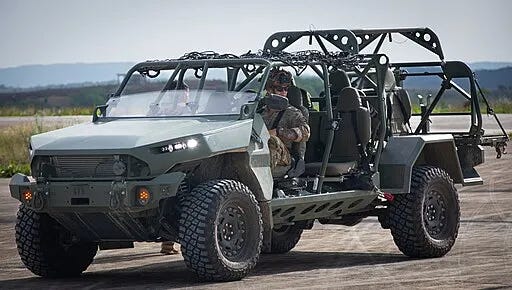
These new ISVs are much lighter and faster, and more comfortable than the Humvees. They are redesigned Chevy Colorado trucks that can be manufactured much quicker on an assembly line. Dr. Miller went to a base in southern Louisiana to observe how the new troop vehicles were being used. Moreover, the ISV can be built and procured by the military for half the cost of the Humvee!
Another indicator of how much the mindset is changing is how these ISVs have been tested. They have been given to Army and National Guard units to operate and test their capabilities in actual missions such as the relief of people during the aftermath of the Hurricane in North Carolina. Humvees were unable to navigate the terrain while the new ISV was able to overcome it.
Other units were given an ISV to use and modify for combat, and even to change into a robotic version to possibly use instead of putting soldiers in harm’s way! Another unit of soldiers brainstormed and developed a lightweight gun turret on top to use as a very mobile fighting vehicle. This is not how such equipment has been built and tested in the past, and it signals a more practical way of understanding how these can be useful because they have been evaluated by personnel who were in combat before, and have seen what does go wrong when older equipment is simply put into use because somebody upstairs said so.
‘Trading blood for steel’
This was the point in the podcast where I was struck by just how different and better the new attitude of the military was in comparison to previous administrations. What they are now trying to accomplish is this, as summarized by Dr. Miller. “Let’s trade blood for steel, and make sure it’s their blood!”
He gave examples such as using robots and robotic vehicles to initiate breaching doors in house-to-house combat so that the first thing through wasn’t a soldier who was likely to get shot or killed. Colonel Butler also noted that they are working on using iPads, in conjunction with Starlink, to conduct battlefield surveillance and communication, and view and communicate with everyone at once, instead of the outdated drone system currently in use.
According to Col. Butler, our current drone system is operated in an archaic manner. In many cases, the large and heavier drones now used are launched by literally throwing them into the air, much like tossing a paper airplane! Then, they have to be guided by soldiers using an individual computer and server system placed in the field.
Raven drone. Photo courtesy of Wikipedia
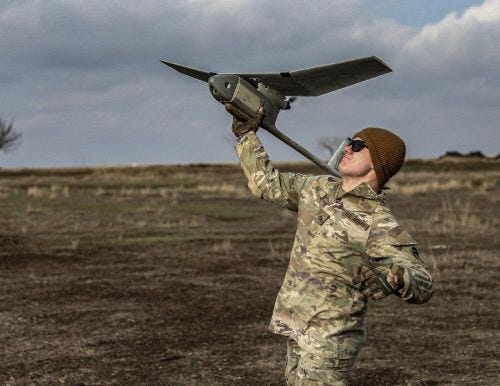
What is being proposed is replacing the drones with smaller ones, commercially produced in America, and operated with a smartphone application! Col. Butler also noted that these newer drones would cost ten times less than the current ones!
There were more examples given by both men during this revealing podcast episode. They ranged from equipment and tech innovation to how money could be spent more efficiently in the budget.
However, these innovative ideas are not without opposition, especially the kind expressed by self-interested politicians. Both men noted various examples of this.
Congressional representatives have been resistant to these kinds of changes before, citing concerns that outdated equipment was manufactured somewhere in their district and they were loath to see that changed.
Despite the opposition, both in government and out, both men expressed a genuine optimism that they could be overcome, and a better Army, much more capable of defending our nation, would result. I am very hopeful they are right, so that we can be assured that a stout and effective fighting force will soon be in place. As a veteran, I am praying for the success of these efforts.
The teaching of the wise is R13a fountain of life, that one may R14turn away from the snares of death. Proverbs 13:14 ESV
D.T. Osborn
Sources: The Holy Bible, English Standard Version, Crossway Bibles, 2001
All other sources cited in the text